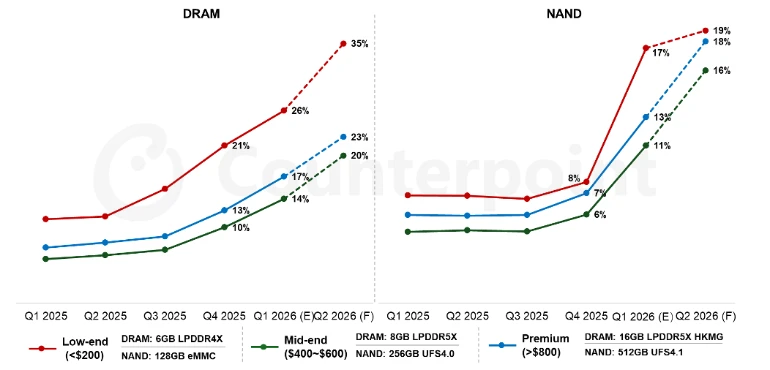
Smartphone prices are likely to go up in 2026. According to Counterpoint Research, the main reason is the sharp increase in memory costs. DRAM prices rose more than 50 percent quarter-on-quarter, while NAND Flash jumped over 90 percent in Q1 2026.
Budget phones under $200 are the most affected. Their bill of materials (BOM) went up 25 percent, with memory now making up 43 percent of total costs. Mid-range phones are also feeling the squeeze, with DRAM and NAND expected to reach 20 percent and 16 percent of BOM by Q2 2026.
Flagship phones face even bigger challenges. BOM costs are projected to rise by $100 to $150, with memory taking up nearly one-fifth of total costs. Add in the higher prices of advanced processors, and premium devices will be much more expensive.
Manufacturers are trying to cope by cutting shipment targets for low-end models and adjusting specs. Still, price increases look unavoidable. Entry-level phones may go up by around $30 (around ₱2,000), while flagships could increase by $150 to $200 (around ₱9,000 to ₱12,000).
On top of this, the ongoing conflict between the US, Israel, and Iran is expected to disrupt global trade. Any supply chain issues could push smartphone prices even higher, adding to the pressure already caused by rising memory costs.
Also Read: How the Middle East conflict affects smartphone prices
Counterpoint warns that brands will struggle to balance costs, margins, and shipments throughout 2026. Consumers should expect higher prices across all smartphone segments.
Source: 1