
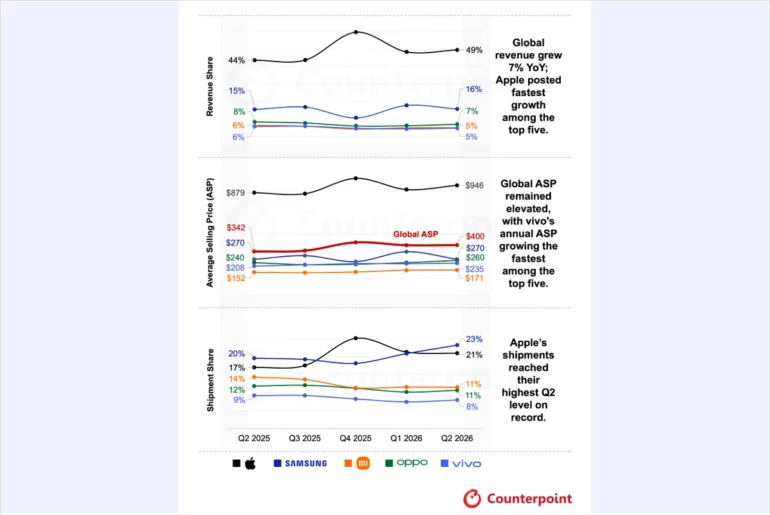
Smartphone revenue rose despite shipment declines in Q2 2026, hitting $109 billion, up 7% year-on-year, according to Counterpoint. Average selling prices jumped 17% to $400 as buyers leaned toward premium models and brands raised prices.
Apple led the market with a record 49% revenue share, growing 22% year-on-year. Strong demand for the iPhone 17 lineup and steady pricing helped the company absorb rising costs. Samsung followed with a 16% share, posting 9% growth from Galaxy A-series and Galaxy S26 sales, especially in the Middle East & Africa (MEA) and North America.
Xiaomi faced a tough quarter, with shipments down 26% and revenue falling 17% despite a 13% rise in ASP. The brand shifted focus to premium and upper mid-tier models, but demand stayed weak. OPPO and vivo also saw revenue drops of 10–11%, with ASP gains of 9–13% unable to offset shipment losses.
The overall market trend shows brands pushing higher prices and premium tiers to protect margins. OEMs are using vertical integration and selective price increases to keep ASPs stable. Apple and Samsung managed to hold ground, while Chinese brands struggled with weaker demand and shipment declines.
Also Read: IDC puts Samsung first in Q1 2026, Counterpoint says Apple
“The global smartphone market has entered a new phase where shipments are no longer the primary driver of growth; instead, value has become the key growth lever, with rising component costs acting as a catalyst,” said Counterpoint Senior Analyst Shilpi Jain.
“With the entry tier shrinking and facing cost pressures, most OEMs are shifting away from volume-driven strategies, passing higher Bill of Materials (BOM) costs on to consumers, upselling higher-storage and higher-configuration models, and focusing on the premium segment,” Jain adds.
Analysts expect supply issues to continue in the second half of 2026. This could cut shipments further but keep ASPs high, as brands rely on premium models to drive revenue. The industry is shifting toward fewer units sold but higher value per device, showing how consumer demand is changing.
